We remain fully operational. Our teams are working around the clock to ensure your deliveries continue safely.

DOWNLOAD THE APP


Copyright © 2025 Desertcart Holdings Limited
DOWNLOAD THE APP
Buy anything from 5,000+ international stores. One checkout price. No surprise fees. Join 2M+ shoppers on Desertcart.
Desertcart purchases this item on your behalf and handles shipping, customs, and support to Sweden.
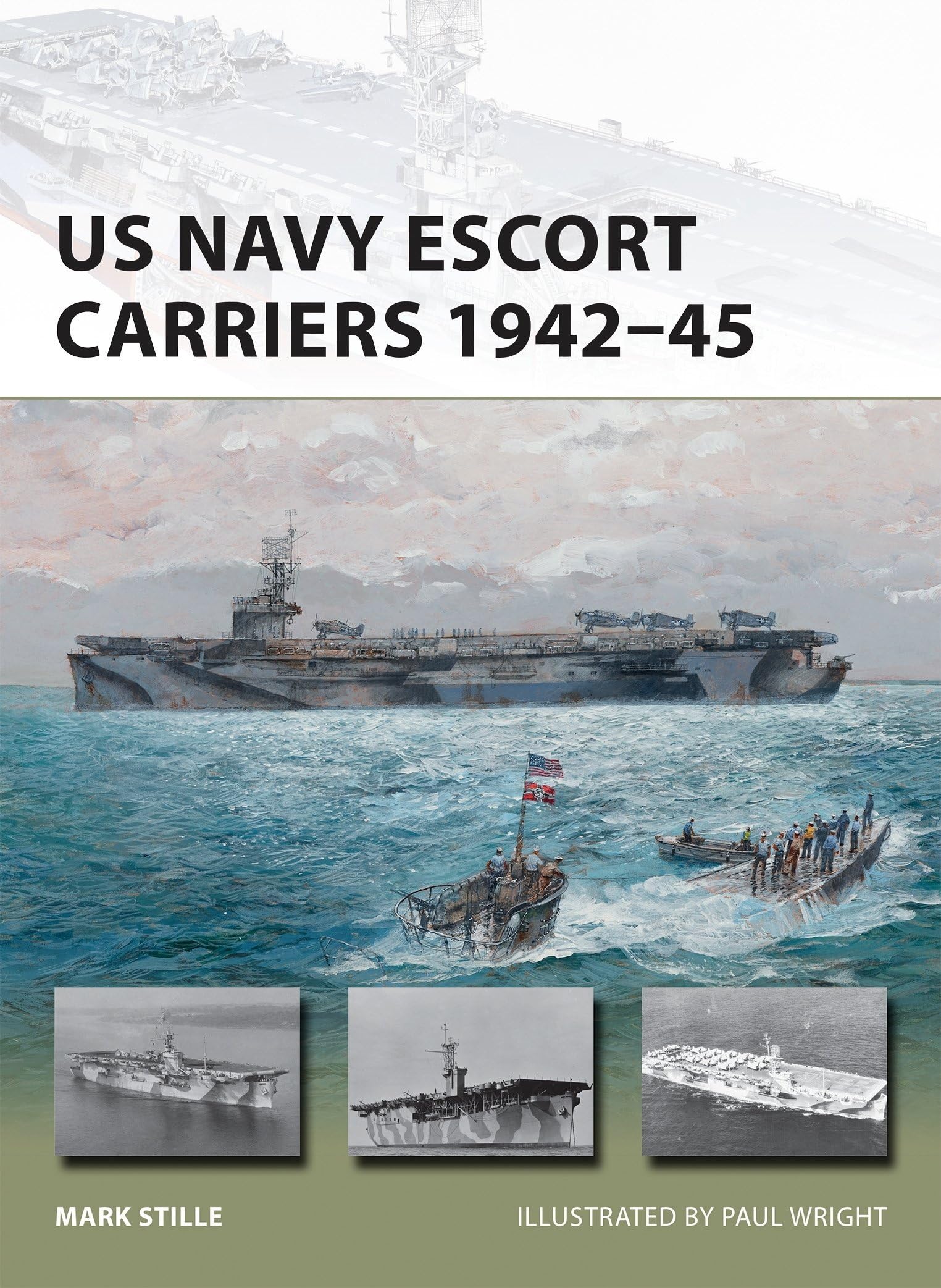
US Navy Escort Carriers 1942–45 (New Vanguard, 251) [Stille, Mark, Wright, Paul] on desertcart.com. *FREE* shipping on qualifying offers. US Navy Escort Carriers 1942–45 (New Vanguard, 251) Review: Escort carriers in WWII. - Mark Stille has given us another excellent title on the US Navy during WWII in this Osprey New Vanguard 251 "US Navy Escort Carriers 1942-1945". As with any Osprey title, it is full of excellent illustrations, period photos and color plates. The author begins with the impetus for the escort carrier in which US President Franklin Roosevelt wanted a cheap, quickly-built small carrier with a small aircraft complement for escort duties in the Atlantic. While the US Navy didn't want them, the President got what he wanted. Stille lays out the evolution of escort carrier design as time went on and the war progressed. Another Presidential intervention resulted from a conversation with Henry Kaiser who promised Roosevelt fifty escort carriers in one year. Once again, the president had his way and Kaiser delivered in another one of those amazing performances of American industry. The author looks at the aircraft complements, the ratio between fighters and attack aircraft and how that changed depending on the theater and time. The volume looks at the kinds of weapons and radar available to these ships as well. The author looks at the service of these "jeep" carriers in Atlantic where they were focused on antisubmarine warfare and in the Pacific where they performed a variety of tasks including lending air support for invasion forces, ASW and as ferries of aircraft to make up losses on the fleet and light carriers and of US Army aircraft to remote locations. Lastly, it looks at the classes of these small, but useful, ships, how many were produced and their fates. This is a good work on a class of ships that did yeoman service everywhere they were deployed. The reader gets a lot from a relatively short, 48-page book. Review: Buy it IF you can find it cheap used. - Some new data, but a good read and some interesting, but not complete history.


| Best Sellers Rank | #577,636 in Books ( See Top 100 in Books ) #190 in History of Military Vehicles #974 in Naval Military History #3,749 in World War II History (Books) |
| Customer Reviews | 4.6 out of 5 stars 135 Reviews |
S**G
Escort carriers in WWII.
Mark Stille has given us another excellent title on the US Navy during WWII in this Osprey New Vanguard 251 "US Navy Escort Carriers 1942-1945". As with any Osprey title, it is full of excellent illustrations, period photos and color plates. The author begins with the impetus for the escort carrier in which US President Franklin Roosevelt wanted a cheap, quickly-built small carrier with a small aircraft complement for escort duties in the Atlantic. While the US Navy didn't want them, the President got what he wanted. Stille lays out the evolution of escort carrier design as time went on and the war progressed. Another Presidential intervention resulted from a conversation with Henry Kaiser who promised Roosevelt fifty escort carriers in one year. Once again, the president had his way and Kaiser delivered in another one of those amazing performances of American industry. The author looks at the aircraft complements, the ratio between fighters and attack aircraft and how that changed depending on the theater and time. The volume looks at the kinds of weapons and radar available to these ships as well. The author looks at the service of these "jeep" carriers in Atlantic where they were focused on antisubmarine warfare and in the Pacific where they performed a variety of tasks including lending air support for invasion forces, ASW and as ferries of aircraft to make up losses on the fleet and light carriers and of US Army aircraft to remote locations. Lastly, it looks at the classes of these small, but useful, ships, how many were produced and their fates. This is a good work on a class of ships that did yeoman service everywhere they were deployed. The reader gets a lot from a relatively short, 48-page book.
S**S
Buy it IF you can find it cheap used.
Some new data, but a good read and some interesting, but not complete history.
H**E
Escort carriers in action...
The U.S. Navy had a desperate need for aircraft carriers in the early days of World War II. That need was such that it resorted to converting merchant vessels, tankers, and other warships into small, make-shift aircraft carriers. In the end, the so-called escort carriers made an enormous contribution to victory. Veteran historian Mark Stille here tells their story. "US Navy Escort Carriers 1942-45" captures the development and continuing evolution of the escort carrier during the Second World War. Of particular interest to this reviewer was the brief but informative narrative of their combat actions. These actions included anti-submarine warfare in the Battle of the Atlantic, air support for Operation Torch in North Africa and for landings in various Pacific islands, and the ferrying of aircraft and troops around the Pacific Ocean. A surprising highlight was the underpublicized success of the escort carriers against German U-boats. A better-known highlight was the Battle of Samar in October 1944, in which a Japanese surface fleet surprised a group of escort carriers off the Philippines. The book includes a review of each class of escort carrier, and the fate of the vessels within that class. The text is supplemented with a nice selection of period photographs, diagrams, and modern illustrations. There is a lot of detail crammed into a book less than 50 pages long. Highly recommended as an excellent introduction to an often overlooked aspect of the Second World War at sea.
P**N
Good book.
Good summary.
M**6
Excellent Primer on Escort Carriers.
A lot of excellent information in this 48 page book, reviewing the development, design and operational use of escort carriers in WW2. The photos are small, but very clear, line are & color diagrams show the "jeep carriers' to good effect. The writing is clear, concise and informative. Great primer for anyone interested in naval operations in WW2. These carriers served in both the Atlantic & Pacific, sinking enemy submarines, ferrying planes, supporting land operations. About 1/2 the size of a fleet carrier, these ships used merchant ship hulls and once production was up and running, were produced in as little as three months. Recommended!
J**N
Four Stars
GOOD REVIEW
A**R
Escort Carriers ... crucial players on TEAM NAVY
My father served on a CVE in World War II as Air Combat Intelligence Officer. The daring airmen on these ships ( ...”CVEs, they look just like a piece of cheese” . was a silly ditty we all loved...) flew right at the enemy and gunned him out of the way so that larger aircraft from larger ships could achieve their crucial strategic goals. This astonishing, wonderful and HONEST history brings well-deserved and genuine honor to a too.-often overlooked strategic unit of our Great American Navy’s Greatest Hour. I have shared it with many MANY equally-elderly friends, all my brothers, and everyone LOVES it!!
B**.
Good for 40+ pages. Evolution of concept, design and construction histories, operations.
It’s a good 40+ pages booklet on American escort carriers of WW II. It discusses the development and evolution of the concept of the cheap and quickly built escort carrier, armament, operations in the Atlantic and Pacific Oceans, and the design development and construction histories of the various classes of ships. The latter information is mostly taken from the book “U.S. Aircraft Carriers” by Friedman (1983). Pages 46 - 47 summarize the development and combat uses of the ships. Five classes were built: “Long Island” / “Charger” (the first conversions from cargo ships), “Bogue,” “Sangamon,” “Casablanca,” and “Commencement Bay.” One hundred forty escort carriers were ordered and 124 constructed, with 16 cancelled at the end of the war, i.e., 19 of the 35 planned “Commencement Bay” class were completed.
Trustpilot
2 weeks ago
4 days ago